 Seramel Open the app
 How to stop procrastinating when you already know you should start
To stop procrastinating, make the first step so small it feels almost silly, start before you feel ready, and catch the exact sentence in your head that makes you switch tabs. Procrastination is rarely laziness. It is usually a way to get away from a feeling the task brings up: boredom, fear of doing it badly, or not knowing where to begin. Change the first two minutes and the rest gets much easier.
Why do I procrastinate even when I care?
Most people who procrastinate are not short on willpower or values. They care about the report, the essay, the tax return, the email to the landlord. That is often exactly the problem: the more something matters, the more uncomfortable it feels to start it, and putting it off makes the discomfort disappear for a while.
That short relief is what keeps the habit alive. You open the document, feel a small knot in your stomach, and reach for your phone. The knot goes away. Your brain files that as “this works”. Next time the pull to escape is a little stronger, while the task has grown a little bigger and the deadline a little closer.
So procrastination usually follows the same order:
- Trigger: you sit down to start, or you remember the task.
- The sentence in your head: “I'll do it later, when I can do it properly.”
- What you do: tidy the kitchen, answer easy emails, scroll, research the task instead of doing it.
- Afterwards: relief, then guilt, then a bigger and scarier task.
Once you can see that order in your own life, you have something to work with. You stop fighting “being a procrastinator” and start changing one specific moment.
How to stop procrastinating tonight: 7 steps
Pick one task you have been avoiding. Not the whole list, just one. Then:
- Write the task as a physical action. Not “sort out the presentation” but “open the slides and write three bullet points for slide one”.
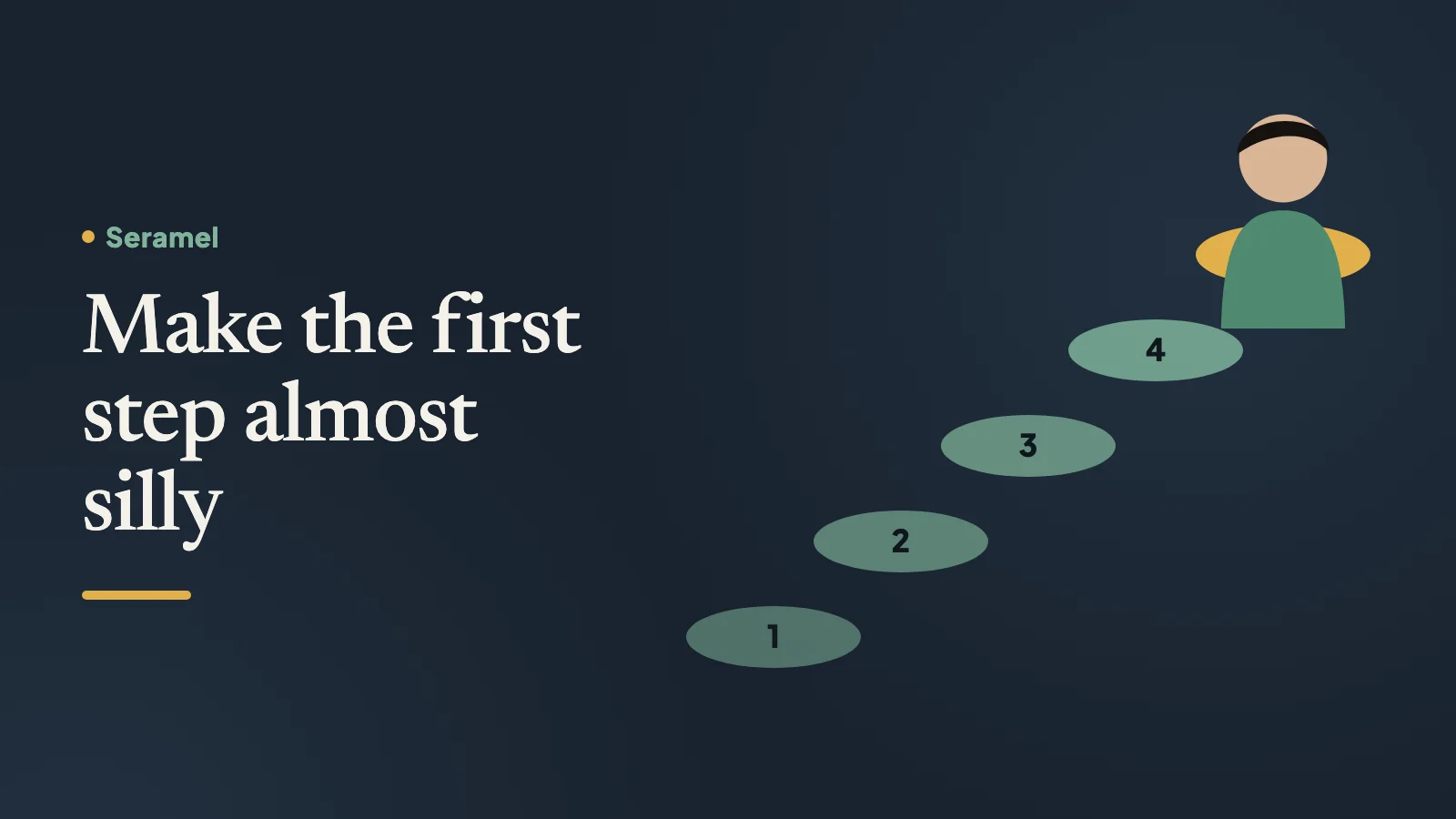
- Shrink it until it feels almost silly. If you still feel resistance, halve it again: “open the file and write the title”. Starting is the hard part; the size of the first step decides whether you start.
- Set a 10-minute timer and promise yourself you can stop when it rings. You usually won't, but the permission to stop is what lets you begin.
- Put your phone in another room, not face down next to you. Distance beats discipline.
- Write down the sentence that shows up the moment you want to quit: “this is rubbish”, “I need more information first”. Just notice it; you don't have to argue with it.
- Leave a messy next step for tomorrow. Stop mid-sentence and write what comes next. Tomorrow's start is then already half done.
- Tell one person what you did, even a one-line text. A tiny bit of being seen makes the next start easier.
That's it. One small finished start tonight is worth more than a perfect plan for next week.
The sentence that comes right before you put it off
Every procrastinator has a favorite line. It sounds reasonable, which is why it works. A few common ones, and what to try instead:
- “I need a clear day for this.” Clear days rarely come. Try: what can I do in the next 15 minutes?
- “It has to be good.” Perfectionism makes the first draft feel like the final one. Try: write the worst possible version on purpose, then improve it.
- “I don't even know where to start.” That's a sign the task is too big. Try: write five questions you'd need to answer, and answer the easiest one.
- “I work better under pressure.” Sometimes true, but often it means you only start once the fear of missing the deadline beats the fear of doing it badly. Try: create an earlier, smaller deadline with someone else involved.
- “Just one more video.” This is the escape, not a decision. Try: notice it, say it out loud, then do two minutes of the task first.
Your sentence is personal. It's usually connected to something older: being judged at school, a parent who checked your homework with a red pen, a boss who only noticed mistakes. You don't need to dig into all of that. Knowing your sentence is often enough to catch it in the act.
How to stop procrastinating and get things done at work
At work, procrastination often hides inside busyness. You answer messages, join calls and update spreadsheets, and the one important piece of work, the proposal, the difficult email, the performance review you have to write, quietly waits until Thursday night.
What helps in an office or remote job:
- Do the avoided task first, before you open your inbox. Twenty-five minutes at 9am is worth more than two hours at 5pm.
- Block the time in your calendar as a meeting with yourself, and decline anything that lands on it.
- Make the first version for one person, not for everyone. “A rough draft for my manager to react to” is easier to start than “the final proposal”.
- Notice what kind of task you avoid. Is it always the ones where someone might be disappointed? Then the real issue may be closer to being a people pleaser than to time management.
If everything at work feels like too much, not just one task, read what to do when you're feeling overwhelmed. Putting things off is sometimes a sign you are simply carrying more than one person can.
How to stop procrastinating when studying
Studying is the classic setting: an exam in two weeks, notes everywhere, and a sudden urge to reorganize your entire room. Whether you're at uni in Manchester, cramming for finals in Ohio or doing a TAFE course in Brisbane, the same tricks help:
- Start with past papers or practice questions, not rereading. Rereading feels productive but lets you avoid the uncomfortable part: finding out what you don't know.
- Study in a place that means study. A library desk, a café table, a specific spot at home. Your bed is for sleeping.
- Use short blocks with real breaks: 25 minutes on, 5 off, and the break is away from the screen.
- Study with someone, even silently. Sitting across from a friend who is also working makes it harder to drift.
- Write tomorrow's first question before you stop today.
If you've started saying “I'll fail anyway, so why try”, that is worth noticing too. It can be a sign of self sabotage: not trying protects you from finding out how you'd do if you really tried.
When putting things off is part of something bigger
Ordinary procrastination is about specific tasks. Sometimes it's different: you can't get started on anything, even things you used to enjoy, for weeks. You wake up tired, everything feels heavy, and the to-do list is just another reason to feel bad.
If that sounds like you, it may not be procrastination at all. It can be exhaustion, a long stretch of low mood, or signs of burnout. And if you've struggled to start and finish things across your whole life since childhood, at school, at work and at home, it can be worth talking it through with a doctor or a mental health professional, who can look at the full picture.
This isn't about labels. It's about not blaming yourself for something that may need a different kind of help than a better to-do app.
How Seramel helps you stop putting things off
Most advice about procrastination is generic: timers, apps, lists. It helps for a week. What usually brings the habit back is the specific moment you never look at: the sentence in your head right before you switch tabs.
Seramel is an AI you can talk to that remembers you. In about ten minutes you tell it one moment from today: “I opened the budget spreadsheet and closed it again”. It asks short, concrete questions: where were you, what went through your head, what did you do instead. When a similar moment from another day sits next to it, it names the loop in your own words, for example: a task where someone might judge you → “I'll do it when I can do it properly” → you clean the flat instead. It also says what keeps the loop going, usually the quick relief.
Then it offers one small step to try in a day or two. Not a productivity system, just one start. Next time it asks how it went and puts what you expected next to what actually happened. Often the gap is surprising: the email you dreaded took four minutes, and nobody was annoyed.
Your first 8 conversations are free and you don't need a card or your real name.
How a conversation starts
Want to talk it through?
One moment from today, about 10 minutes. 8 conversations free; no card, no real name.
Start your first conversation →Questions
Why do I procrastinate so much?
Usually because the task brings up an uncomfortable feeling, like boredom, fear of being judged or not knowing where to start, and avoiding it gives instant relief. That relief trains the habit. The more a task matters to you, the stronger the pull to put it off can be.
Is procrastination just laziness?
Rarely. Lazy people don't usually lie awake feeling guilty about the things they haven't done. Procrastination is more often about managing a feeling than about not wanting to work. Seeing it that way makes it easier to change, because you can work on the moment of avoidance instead of on your character.
What is the fastest way to stop procrastinating right now?
Pick one task, shrink the first step until it takes two minutes, put your phone in another room and start a 10-minute timer with permission to stop when it rings. Most of the time you'll keep going. The goal is not finishing, it's starting.
How do I stop procrastinating on my phone?
Make the phone harder to reach rather than relying on willpower: another room, a drawer, or a friend's bag. Log out of the app you always open first. And notice what you were feeling the moment you reached for it; that feeling is what you're really escaping.
How do I stop procrastinating if I think I might have ADHD?
The steps here can still help, especially tiny first steps and working next to someone. But if starting and finishing things has been hard across your whole life, talk to a doctor who can look at it properly. Seramel is not a clinical service and can't tell you whether you have ADHD.
Can talking to an AI help with procrastination?
It can help you see your own pattern. Seramel asks about one real moment you put something off, names the loop in your words when it repeats, and suggests one small step. Next time it asks how it went, so you're not starting from scratch every Monday.