 Seramel Open the app
An AI to talk to that remembers you and helps you change what repeats
Tell one moment from your day. In about 10 minutes Seramel asks a few short questions, names the loop that keeps pulling you back, in your own words, and you pick one small step. Next time it asks how it went.
Start your first conversation →
What's on your mind?
How it works
Talk — about 10 minutes
Your loop gets a name
One tiny experiment
Then it asks
An AI to talk to that actually remembers you
Seramel is an AI to talk to when something from your day won't leave your head: the comment in the meeting, the argument on the drive home, the text you still haven't answered. You tell it one moment. It asks a few short, concrete questions. And unlike most chatbots, it remembers you next time.
That memory is the point. Most of what weighs on us isn't one bad day. It's the same kind of moment coming back in different clothes: a different boss, a different partner, the same knot in your stomach. Seramel is built to notice that. When similar moments repeat, it names the pattern, which it calls a loop, in your own words: what sets it off, the sentence that goes through your head, what you do next. It also says what keeps the loop going.
Then it does something a friend often can't: it helps you pick one small step to try in the next day or two, and next time it asks how it went. Not a lecture, not a list of tips. One step, then an honest look at what happened.
It's not a clinical service and it doesn't pretend to be a person. It's a thinking tool for adults who'd like to talk things through and change what keeps repeating.
How a conversation with Seramel goes
A conversation takes about ten minutes. Here's what usually happens:
- You tell one moment. Not your whole life, just something from today. “My sister asked me to babysit again and I said yes before she'd finished.”
- It asks about the scene. Where were you, what went through your head, what did you do? Short questions, one at a time. If you'd rather just get something off your chest, say so, and it listens.
- It connects the dots. When this moment sits next to a similar one, maybe from last week with your manager, it names the loop: someone asks → “if I say no, I'm the selfish one” → yes before you've thought. You can correct it; your version is the one it keeps.
- You pick one small step. Something doable within a day or two, like replying “let me check and get back to you” next time.
- Next time, it asks. “Did you try it? What did you expect, and what happened?” Both go side by side on your map, so over weeks you can see what's actually changing.
That's it. No forms, no personality tests, no streaks to protect.
Why remembering matters
If you've ever opened a new chat and had to explain your job, your family and your last three weeks before getting to the point, you know the problem. Without memory, every conversation starts from zero, and patterns are impossible to see.
Seramel remembers across conversations: the people in your life, the loops it has seen, the steps you tried and what came of them, even how you like to be talked to. That's what lets it say, “this sounds like what happened with the client in March”, and what lets the next conversation open with “did you manage to say it?”
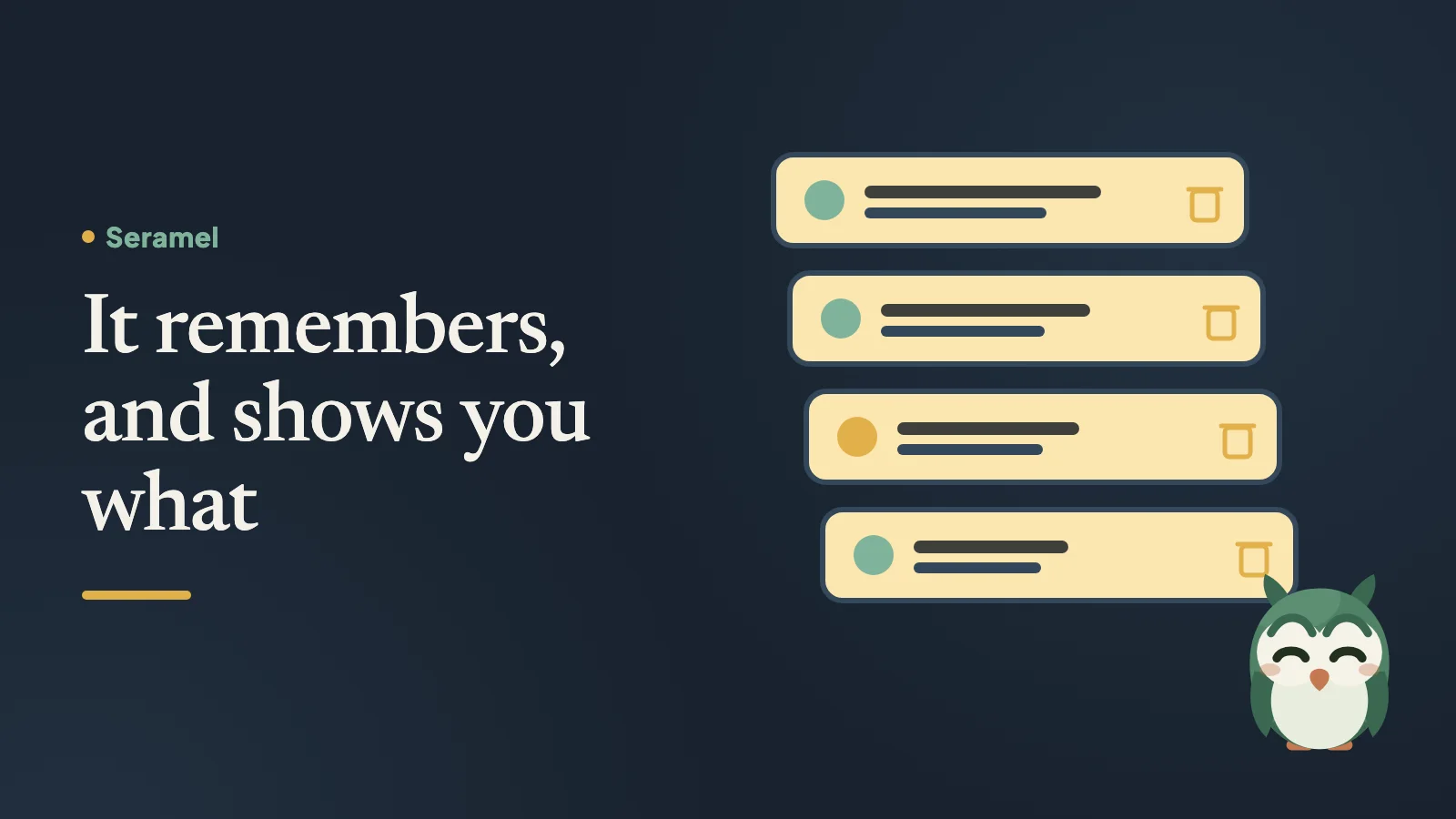
But memory should never be a black box. Everything Seramel remembers about you is listed line by line on the “What I remember about you” page. You can delete any line. You can mark a topic “don't bring this up”, and it won't. Your loops sit on a map, each with the steps you tried and, next to them, what you expected and what actually happened. There's also a journal, a daily mood check-in and gentle reminders for your step.
Who Seramel is for
Seramel is for adults (18+) who notice the same things coming up again and again and would like to do something about it. In practice, that's a lot of people:
- The nurse or warehouse worker on shifts, whose friends are asleep when they finally get a moment to think.
- The graduate who moved to a new city for work and still eats dinner alone most nights.
- The parent doing the school run, the job and the care for an aging mum, who never gets ten minutes without someone needing something.
- The manager who replays every meeting on the commute home.
- The person who's just come out of a relationship and doesn't want to tell their friends the same story for the fifth time.
You don't need a crisis to use it, and you don't need to know what's wrong. “Today felt off and I don't know why” is a perfectly good start. You also don't need your real name; a nickname is fine.
If you're in danger or thinking about harming yourself, an app is not the right place: call your local emergency number now (911 in the US and Canada, 999 in the UK, 000 in Australia, 112 in Europe). Seramel also points you to real people when it sees signs of crisis.
How it's different from a general chatbot or a diary
A general chatbot can do almost anything, which is exactly why it often isn't great at this. You share one sentence and get five paragraphs of advice. It tends to agree with you. And depending on settings, it may know nothing about you next time. Seramel is built for one job: short questions about one real moment, naming what repeats in your words, one small step, and a follow-up.
A diary or journal is private and valuable, but it never writes back. It can't ask the question you're avoiding, and it won't notice that your entries from March and May describe the same loop. Seramel works like a journal that asks good questions and remembers the answers.
A friend knows you in a way no app can, and Seramel isn't trying to replace anyone. But friends get tired, have their own problems, and usually jump to advice. Many people find that talking it through with Seramel first makes the conversation with a friend easier, and shorter.
Privacy, plainly
You'll be telling Seramel things you might not tell anyone else, so here's exactly what happens to them:
- No real name needed. A nickname and an email address are enough.
- Your words are only ever used to write a reply back to you. They're never used to train AI models and never sold.
- Chat text is deleted after 90 days. What Seramel remembers about you stays visible and editable on its own page until you delete it.
- Servers are in Europe.
- Deleting your account deletes everything.
The full details are on the privacy page, and you can read who runs Seramel on the about page.
Your first 8 conversations are free, with no card needed. After that, Premium is {price} a month, and you can cancel anytime. Seramel is a web app today; iOS and Android versions are on the way.
Start with what's on your mind
Not sure where to begin? These guides cover what people most often bring to Seramel, each with practical steps you can try tonight:
- Putting things off: how to stop procrastinating, and why you get in your own way with self sabotage.
- Saying yes to everyone: people pleaser: what it means and how to stop.
- A head that won't switch off: how to stop overthinking, racing thoughts and 3am thoughts.
- Too much at once: feeling overwhelmed and burnout symptoms.
- Feeling alone: feeling lonely and no one to talk to about your problems.
- Letting it out: how to vent to someone and talking to AI about your feelings.
- After it ends: how to get over a breakup.
- Getting to know yourself: why you keep making the same mistakes, self awareness, journal prompts for self discovery and an AI journal that writes back.
What you leave a conversation with
- TRIGGER
- Someone cuts in while you're speaking
- WHAT GOES THROUGH YOUR HEAD
- “Me again… forget it.”
- WHAT YOU DO
- You go quiet and step back
- AFTERWARDS
- You're angry at yourself all evening
- In tomorrow's meeting: “Let me finish my sentence.”
Price
Your first 8 conversations are free — no card.
Then $9.99 a month; cancel anytime.
Your map and cards always stay yours.
Not a chatbot that just listens. Not a blank journal.
General chatbots meet you from zero every time; journals never write back. Seramel remembers, sees what repeats and walks you to one small step. It is not a clinical service; it's a thinking tool for adults who want to see their own repeats. In an emergency, call your local emergency number.
Privacy
No real name needed. What you write is used only to write a reply back to you — never to train models, never sold. Chat text is deleted after 90 days. Your map and memory are yours until you delete your account.
Questions
Is it safe to talk to an AI about your problems?
Seramel doesn't need your real name. What you write is used only to generate replies; your name and e-mail are not sent with it, and nothing is used for training or sold. Conversation text is deleted after 90 days; deleting your account deletes everything. The processors we use are listed in the Privacy Policy.
How is Seramel different from ChatGPT?
Seramel is built for this: it remembers you, keeps replies short, names the loop that repeats in the moments you tell, helps you pick one small step and asks next time how it went. You never have to start from scratch.
What is a loop (or pattern)?
The thing that repeats in the same order on different days, with different people: the triggering moment → the sentence in your head → what you do. Seramel names it in your words.
Is Seramel a health service?
No. Seramel is not a clinical service; it gives no medical opinions or medical care. When it sees signs of crisis, it points you to real people and local helplines.
Is it free?
Your first 8 conversations are free, no card needed. After that $9.99 a month; cancel anytime. Your map and cards always stay free.
Where is my data?
On our servers in Europe. When you delete your account, everything is deleted.
Does Seramel really remember me? Can I see what it remembers?
Yes. Everything it learned from your conversations (how to talk with you, the people in your life, the steps that helped and didn't) is listed line by line on the “What I remember about you” page, and you can delete any of it. Topics you mark “don't bring this up” stay closed unless you open them, and you can delete a single conversation too.
Is there a free AI to talk to?
Seramel's first 8 conversations are free, with no card needed, so you can see whether it suits you. After that, Premium is {price} a month and you can cancel anytime.
How long does a conversation take?
About ten minutes. You tell one moment from your day, answer a few short questions, and leave with one small step if you want one. You can stop whenever you like.
What if I just want to talk, not analyze anything?
Say so. Seramel will listen without turning it into a lesson. Naming a loop only happens when similar moments really repeat, and the small step is always your choice.
Do I need to download an app?
No. Seramel runs in your browser at app.seramel.com on your phone or computer. iOS and Android apps are on the way.
What happens if I'm going through a crisis?
Seramel is not an emergency service. If it sees signs of crisis, it points you to real people and local helplines. If you're in danger right now, call your local emergency number (911 in the US and Canada, 999 in the UK, 000 in Australia, 112 in Europe).